Pneumatic Fenders Indonesia: Reliable Marine Protection for Ports, Terminals & Offshore Operations

Indonesia’s position as one of the world’s major maritime nations continues to drive investment in ports, terminals, shipyards, offshore energy facilities, and other marine infrastructure. With thousands of islands and an extensive network of commercial waterways, safe and efficient vessel operations are essential to keeping cargo, energy, and industrial supply chains moving.

One of the simplest but most critical components in these operations is the marine fender. A properly engineered fender system absorbs and controls the energy generated when a vessel approaches a berth, transfers alongside another vessel, or operates near a fixed marine structure.
For applications where high energy absorption, low reaction force, and operational flexibility are required, pneumatic fenders provide a proven solution. These heavy-duty rubber fenders are widely used in ports, offshore terminals, ship-to-ship (STS) transfer operations, oil and gas facilities, and naval applications.
Why Pneumatic Fenders?
Pneumatic fenders—are cylindrical, inflatable units made of reinforced rubber layers and filled with compressed air. Their design allows controlled deformation under vessel impact, combining high energy absorption with low reaction force. This makes them particularly effective in situations where vessel safety is just as important as structural protection.
Key engineering advantages include:
Energy absorption efficiency: Compressed air absorbs kinetic energy during berthing.
Low reaction force: Reduces stress on hulls and structures.
Large contact area: Distributes loads across the hull, minimizing localized pressure.
Operational flexibility: Available in multiple sizes, easily deployed, repositioned, or recovered.
These characteristics make pneumatic fenders suitable for diverse applications, from sheltered port berths to demanding offshore ship-to-ship (STS) transfers.
Applications in Indonesia

Ports & Terminals
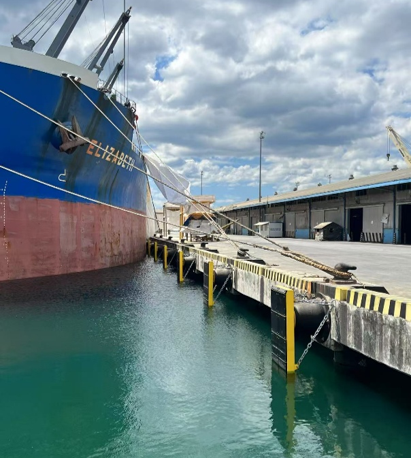
Indonesia’s ports handle vessels ranging from domestic ferries to international tankers. Pneumatic fenders provide adaptable protection for berths, dolphins, jetties, and floating terminals. Their flexible mounting options allow integration into complex berth geometries and varying operating conditions.
Ship-to-Ship Transfers
STS operations require continuous separation between vessels despite relative motion caused by waves, wind, and currents. Pneumatic fenders excel here, maintaining reliable spacing and absorbing dynamic loads. Engineering assessments must consider vessel displacement, freeboard differences, and sea-state conditions to ensure safe cargo transfer.
Offshore Energy Facilities
FPSOs, FSOs, LNG terminals, and offshore supply bases demand fender systems capable of withstanding harsh environmental loads. Pneumatic fenders can be engineered for these conditions, but proper selection requires detailed analysis of wave, wind, current, and vessel motion. Offshore projects often require customized arrangements beyond standard dimensions.

Standards & Quality Assurance
Marine fenders are safety-critical components, and their performance needs to be predictable. For this reason, recognized international standards and testing procedures play an important role in their manufacture and acceptance.
ESC pneumatic fenders are manufactured in accordance with ISO 17357 requirements, with engineering and application considerations aligned with internationally recognized marine industry practices, including relevant PIANC guidance.
Testing is an important part of this process. Depending on the project requirements, pneumatic fenders can be subjected to performance and compression testing to verify their behavior under load. Testing provides a practical way to confirm that the manufactured product meets the required performance characteristics before it is placed into service.
For major infrastructure projects, documentation and traceability are equally important. Project specifications may require inspection records, material documentation, dimensional checks, test results, and other quality documentation as part of the procurement and approval process.
A marine fender is ultimately part of a larger safety system. Consistent manufacturing quality and appropriate testing therefore matter just as much as the nominal size or appearance of the product.

ESC Engineering Support
PT ESC Steel Indonesia supplies pneumatic fenders up to 4.5m diameter, supported by complete system arrangements—chains, anchors, shackles, and frontal systems. Engineering services include:
Reviewing vessels and berth data
Developing layout drawings and fender arrangements
Supporting installation planning
Incorporating testing and inspection into supply
This system-level approach ensures that fenders perform as intended, not as isolated components.

Selecting the Right Fender
There is no universal fender size. Proper selection depends on:
Vessel displacement and berthing velocity
Approach angle and eccentricity
Environmental conditions (wave, wind, current)
Hull pressure limitations and available compression
Supporting structure configuration
For STS operations, relative vessel movement and stand-off distance are critical. Offshore projects demand additional consideration of environmental loads. Involving the manufacturer early in the design stage reduces uncertainty and ensures engineering alignment.
Partner with ESC

As Indonesia expands its ports and offshore infrastructure, pneumatic fenders provide a proven solution for marine safety. Their combination of energy absorption, low reaction force, and adaptability make them indispensable for port authorities, EPC contractors, and offshore operators.
Partnering with an experienced supplier like PT ESC Steel Indonesia ensures that fender systems are engineered, tested, and installed to meet real-world operating conditions—delivering reliable protection for vessels and marine structures alike.
If you are planning a marine infrastructure project in Indonesia and need pneumatic fenders designed around your vessel and operating conditions, contact PT ESC Steel Indonesia to discuss the application and project requirements.
✉️ chanhonkit@escpile.com ✉️ zulfan@escpile.com 📞+62 21 83709257
Explore ESC pneumatic marine fenders and request a quotation: https://www.escsteel.co.id/marine-rubber-fenders-supply