


Engineering Applications of ESC Vinyl Sheet Piles in Environmental Containment and Water-Control Structures


Modern hydraulic and environmental engineering projects increasingly require barrier systems that provide not only structural retention, but also long-term resistance to corrosion, low-maintenance service life, hydraulic seepage control, and compatibility with environmentally complex sites.
ESC Vinyl Pile’s PESC-24 Vinyl Sheet Pile and Eco seal Vinyl Sheet Pile with co-extruded integrated gasket, and associated installation accessories—has been developed to address these engineering requirements across marine, flood-control, containment, and water-management applications.

ESC identifies these systems as suitable for bulkheads, seawalls, cut-off walls, containment barriers, flood walls, levees, dam stabilization, water-control works, and environmental protection projects, while emphasizing corrosion resistance, UV resistance, easy handling, and long-term durability.

From an engineering standpoint, the ESC range is particularly relevant where the design objective extends beyond conventional retaining performance and includes hydraulic isolation, seepage reduction, aggressive-environment durability, or low-impact installation in fragile sites. The standard PESC-24 vinyl sheet pile profile is presented by ESC as a permanent vinyl section with resistance to corrosion, impact, and ultraviolet degradation, while the Eco seal variant adds a soft PVC gasket fused into the female interlock to improve watertightness after installation. The system is supported by accessories such as universal corner elements, as well as a PESC steel mandrel to improve alignment and depth attainment during pile driving in more difficult ground conditions.
Product Characteristics
1. Standard PESC Vinyl Sheet Pile

ESC’s product page identifies the PESC-24 as a box-profile vinyl sheet pile designed for permanent applications across a range of soil and environmental conditions. The profile is marketed as providing excellent resistance to corrosion, impact, and ultraviolet rays, with the additional benefit of being lightweight relative to traditional steel or concrete alternatives. ESC also notes compliance with ASTM D8427-21 for rigid PVC exterior profiles used for sheet piling and references USACE EM 1110-2-2502 for flood walls and hydraulic retaining walls.
The published section variants include PESC-24-6.4, PESC-24-7.6, and PESC-24-9.0, all with a 24 in section width and 9 in depth, but with increasing wall thickness and corresponding gains in section modulus, moment of inertia, allowable moment, and unit weight. This gives the designer a range of stiffness and bending resistance options depending on embedment depth, retained height, environmental loads, and serviceability requirements.
2. Eco seal Vinyl Sheet Pile with Integrated Gasket

For projects with higher hydraulic performance requirements, ESC offers the Eco seal profile, which uses the same general section family but incorporates a soft PVC gasket co-extruded into the female interlock during manufacturing. ESC specifically describes this as a specialized seepage-control solution developed in response to engineering demand for improved cut-off performance.
Eco seal is intended for hydrotechnical, civil engineering, and environmental protection projects requiring low hydraulic conductivity rates and durability. Common lengths are noted as typically ranging from 8 ft to 40 ft, depending on project requirements.
This interlock-integrated approach is significant from an engineering perspective because joint permeability often governs the actual cut-off efficiency of sheet pile barriers, especially in environmental or groundwater management applications. A gasket that is integrated during manufacturing, rather than added as a site-applied accessory, provides a more controlled and repeatable sealing interface across the wall system. ESC’s description of the gasket as creating a seamless and watertight connection makes Eco seal the more appropriate selection where seepage reduction is a primary design criterion rather than a secondary benefit.
3. Accessories and Installation Aids
ESC also offers universal corner connections compatible with all listed PESC profiles and designed to accommodate 45°, 90°, and 135° changes in direction, which is important for environmental enclosures, hydraulic chambers, and irregular perimeter works. In addition, the PESC Mandrel is described as a steel guide used with vibratory hammers to assist with alignment, profile protection, driving efficiency, and design-depth attainment, especially for longer sections or more demanding soil conditions. ESC recommends mandrel use for profiles exceeding 9 ft in length and for soils requiring more than 15 nSPT, which directly relates to constructability planning in field conditions.
Environmental and Hydraulic Projects
ESC’s application literature identifies several broad engineering use categories for its vinyl sheet piles, including containment and cut-off systems, water control structures, flood protection, and marine structures. For containment applications, ESC explicitly lists groundwater cut-off, chemical containment, fluid seepage barriers, and protection of foundation structures.
For water-control works, the company cites use in river weirs, pond linings, channel linings, drainage systems, and baffle walls for water or wastewater flow control. The site also identifies flood walls, levees, and dam stabilization as typical hydraulic applications.
These application categories align closely with engineering scenarios where the required performance envelope includes:
ESC supports this positioning by emphasizing that vinyl sheet piles are not affected by corrosion, require no toxic coatings, are highly resistant to seawater and chemicals, and are not affected by marine borers, while also offering a 50+ year design life and transferable warranty language across its applications literature.
1) Separation Barriers Around Contaminated Areas
Engineering Objective
In contaminated land applications—such as municipal landfill perimeter barriers, waste containment cells, legacy industrial sites, or seepage interception zones—the primary design objective is usually the creation of a vertical hydraulic cut-off that limits the lateral migration of contaminated groundwater or leachate. The barrier must therefore provide both structural continuity and low hydraulic transmissivity while maintaining durability in potentially aggressive chemical environments.

Why Eco seal Is Technically Appropriate
ESC’s Eco seal system is particularly well aligned with this application because the company specifically describes it as a specialized seepage solution with an integrated soft PVC gasket that improves wall watertightness after installation. ESC also directly identifies chemical containment, fluid seepage barriers, and groundwater cut-off as intended applications. In a landfill or contaminated-ground enclosure, this makes Eco seal more technically appropriate than a conventional non-sealed interlock profile where interlock leakage may control overall barrier performance.
Material Durability Considerations

Material compatibility is central to barrier design. ESC positions vinyl sheet piles as chemically and corrosion resistant and highlights that the material does not corrode like steel in aggressive environments. For contaminated sites, this is a major engineering advantage because the long-term section integrity is not dependent on corrosion allowances, protective coatings, or sacrificial thickness assumptions. Since the gasket is also PVC-based, the system offers compatible material behavior at both the profile and joint level.

Constructability Considerations
.Barrier continuity depends heavily on installation accuracy, particularly where the piles must reach a competent low-permeability stratum or a prescribed cut-off depth. ESC states that vinyl sheet piles are compatible with traditional driving equipment and notes that the mandrel improves installation speed and helps ensure design depth is attained. For environmental cut-off walls, where incomplete penetration can create preferential seepage pathways below the wall toe, this is a highly relevant installation consideration.
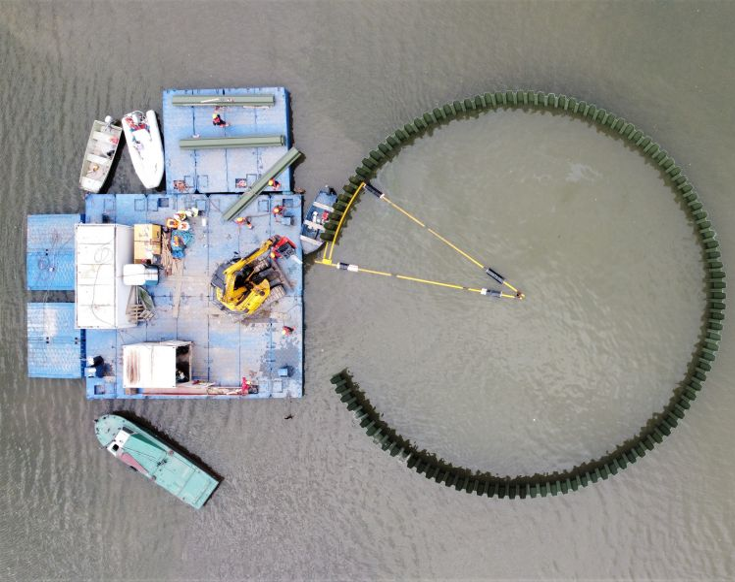
2) Construction of Artificial Islands for Birds
Engineering Objective
Artificial bird islands are essentially engineered habitat-retention structures. Their function is to create elevated nesting platforms that remain stable under changing water levels, minimize erosion of the perimeter, and reduce access by predators. From a geotechnical and hydraulic standpoint, the perimeter structure must resist lateral soil pressure from retained fill, manage exposure to fluctuating water elevation, and maintain long-term geometry without rapid deterioration.
Relevance of ESC Vinyl Sheet Piles
Although bird islands are not a conventional heavy civil application, the engineering requirements match the strengths ESC attributes to its vinyl profiles: durability in wet environments, corrosion resistance, lightweight handling, and long-term structural reliability.
ESC repeatedly states that its vinyl piles are suitable for water-exposed permanent structures and are effective alternatives to steel, concrete, and timber. In habitat projects where the structure is expected to remain in place for years with minimal maintenance, the corrosion-free nature of vinyl becomes particularly valuable.
Hydraulic and Ecological Design Benefits
The perimeter wall formed by the sheet piles can help preserve nest elevation above seasonal water fluctuations and reduce edge erosion during high-water periods. Because ESC’s vinyl sheet piles require no toxic coatings, they are also more appropriate in ecological settings than some conventional materials that rely on chemical preservation or surface protection systems.
The use of corner elements further supports non-linear perimeter configurations, allowing designers to optimize island geometry for habitat performance and hydraulic conditions.

Installation Considerations
Habitat sites often involve low bearing capacity soils, limited access, and a need to reduce construction disturbance. ESC emphasizes that vinyl sheet piles are substantially lighter than steel alternatives and may be installed under certain conditions using an excavator or vibrohammer. This lower handling weight can reduce equipment demand and simplify work within protected or soft-ground sites.

3) Counteracting the Drying Up of Peat Bogs and Wetlands
Engineering Objective
In peatland and wetland rehabilitation, the intention is often to raise local water tables, reduce uncontrolled drainage, and restore sustained saturation of organic soils. From a hydraulic engineering perspective, this commonly involves the installation of subsurface seepage barriers, micro-retention structures, or localized flow-control elements that interrupt drainage pathways and retain water within the target ecological zone.

Role of Vinyl Sheet Piles in Wetland Water Retention

ESC’s applications literature specifically identifies vinyl sheet piles as suitable for water control structures and cut-off systems, both of which are directly relevant to wetland restoration. The pile wall can function as a low-permeability barrier that reduces lateral drainage from a peat body or intercepts flow in shallow channels that are dewatering the site. In this application, the objective is not necessarily a high retaining wall, but rather a hydraulic discontinuity that slows water loss and stabilizes the local hydrological regime.
Material and Lifecycle Suitability
Peat and wetland environments are frequently acidic, permanently saturated, and difficult to maintain once construction is complete. ESC’s emphasis on corrosion resistance, chemical resistance, UV resistance, and low-maintenance design life exceeding 50 years makes vinyl an appropriate choice where long-term durability is required despite limited site access for repairs. Unlike steel, the barrier’s long-term viability is not undermined by oxidation in wet conditions, and unlike timber, it is not susceptible to biological deterioration or borers in relevant exposure conditions.

Sustainability Considerations
ESC also states that vinyl sheet pile solutions can have significantly lower carbon emissions than steel solutions and emphasizes that no toxic coatings are required. For peatland restoration, this matters both from a project-embodied-carbon standpoint and because restoring saturated peat conditions can reduce oxidation of stored organic material. While the carbon-storage performance of specific wetlands would need site-specific environmental assessment, the combination of low-maintenance material selection and water-retention function makes vinyl sheet piles highly relevant to restoration-focused engineering strategies.
4) Small Retention Structures, Sluices, and Fish Ladders
Engineering Objective
Small retention works are designed to manage runoff, regulate water elevation, control channel energy, and improve water availability or ecological connectivity. Examples include low-head dams, small sluice structures, weirs, drainage control features, stormwater retention barriers, and fish ladders. In these systems, the sheet pile component may act as a cut-off wall, sidewall, retaining element, flow partition, or erosion-protection boundary.

Alignment with ESC Water-Control Applications
ESC explicitly includes river weirs, pond linings, channel linings for agriculture, drainage systems, and baffle walls for water or wastewater flow control among its water-control applications. The site also identifies use in flood walls, levees, and dam stabilization. This positions the system well for small hydraulic structures where exposure to continuous moisture, fluctuating flow, and long service intervals is expected

Hydraulic Performance Considerations.
For a retention dam or sluice, the engineering challenge is not only resisting lateral hydrostatic and earth pressures but also limiting underflow and interlock seepage. In these cases, the Eco seal system is advantageous where tighter control of hydraulic leakage is required, because ESC states that the integrated soft PVC gasket improves wall watertightness and is intended for applications requiring low hydraulic conductivity. By contrast, the standard PESC profile may be fully appropriate in less seepage-sensitive retention or stabilization works where structural retention is the governing requirement.
Fish Ladders and Ecological Water Structures
Fish ladders introduce an additional hydraulic design consideration: energy dissipation and controlled velocity reduction so fish can pass through grade changes safely. Vinyl sheet piles can serve as sidewalls, flow partitions, small retaining walls, or baffle support elements in these systems. Since such structures remain permanently wet and are often built in environments that do not justify high-maintenance materials, ESC’s corrosion-resistant and durable vinyl sections are particularly suitable. The use of custom corners and accessories can further help configure stepped or segmented geometries required by fish-passage systems.

Product Selection Guidance for Engineers
the primary need is structural retention in a permanent water-exposed environment.
the project benefits from lightweight installation, corrosion resistance, and UV durability.
seepage control is desirable but not the dominant design criterion.
the application involves bulkheads, small retaining systems, water-control walls, embankment support, or habitat perimeter structures.
the design requires enhanced interlock watertightness,
the wall is acting primarily as a cut-off barrier, containment wall, or groundwater control system,
the project involves chemical containment, landfill barriers, fluid seepage control, or environmental protection infrastructure,
low hydraulic conductivity and long-term durability are critical performance requirements
the wall alignment includes corners or irregular plan geometry.
installation is being carried out in longer lengths or higher-resistance soils,
maintaining alignment and achieving required toe levels are important to hydraulic or containment performance.
Conclusion
From an engineering perspective, ESC Vinyl Sheet Piles should not be viewed solely as alternatives for waterfront bulkheads or light marine walls. Based on ESC’s published product and application data, they are also technically viable for a broader set of environmental containment, hydraulic control, and ecological infrastructure works where durability, permeability performance, corrosion resistance, and installation practicality are central to project success.

The standard PESC-24 family provides structural flexibility for permanent retaining and water-control works, while Eco seal extends the system into higher-performance seepage-control applications through its co-extruded gasketed interlock design. Combined with ESC’s corner elements and mandrel-assisted installation capability, the product range can be adapted for technically demanding projects such as contaminated land barriers, bird island retention systems, peatland and wetland restoration barriers, and compact retention structures including fish ladders and sluices.
For owners, consultants, and contractors seeking a low-maintenance, chemically resistant, corrosion-free sheet pile solution for environmental and hydraulic engineering, ESC Vinyl Pile offers a practical platform for long-life performance in conditions where traditional materials often face accelerated degradation or higher lifecycle costs.


ESC vinyl sheet pile catalog
Let’s Engineer Your Solution: Speak with our team to discuss your project requirements and discover the right vinyl sheet piling system for your application.
Contact us:
🌐 www.escvinylpile.com | 📞 +1 (980) 689 4388 | 📧 info@escvinylpile.com


